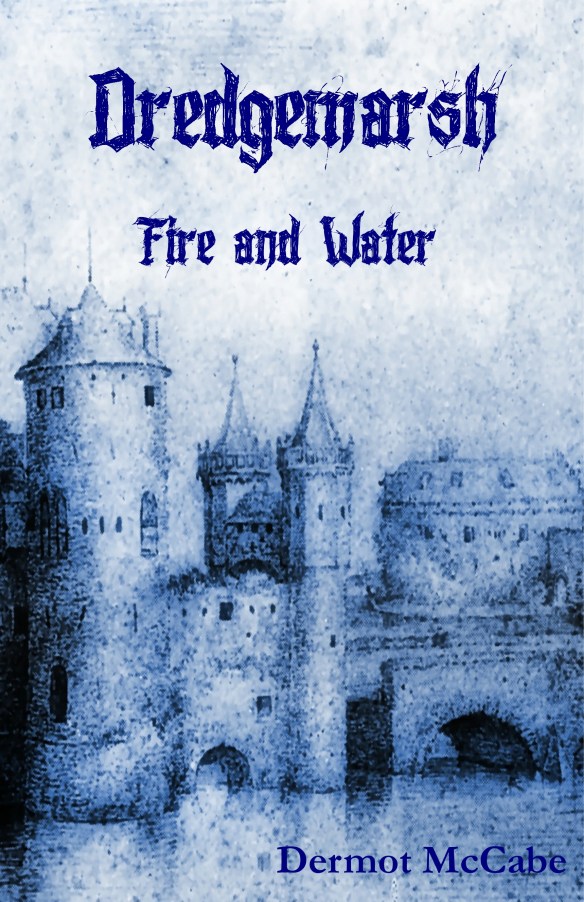
Dredgemarsh : Fire and Water Review

Review by Patricia Killeen

Dredgemarsh: Fire and Water is a stunning book by writer Dermot McCabe—I didn’t expect to enjoy it so much, as I’m not usually into medieval world type sagas, and as I borrowed it from my daughter, I think its probably a more ‘young adult historical adventure genre’, but the story grabbed me from the first page and just refused to let go. The writing flows, and I was surprised to be seduced into a mythical world that also felt weirdly intimate.

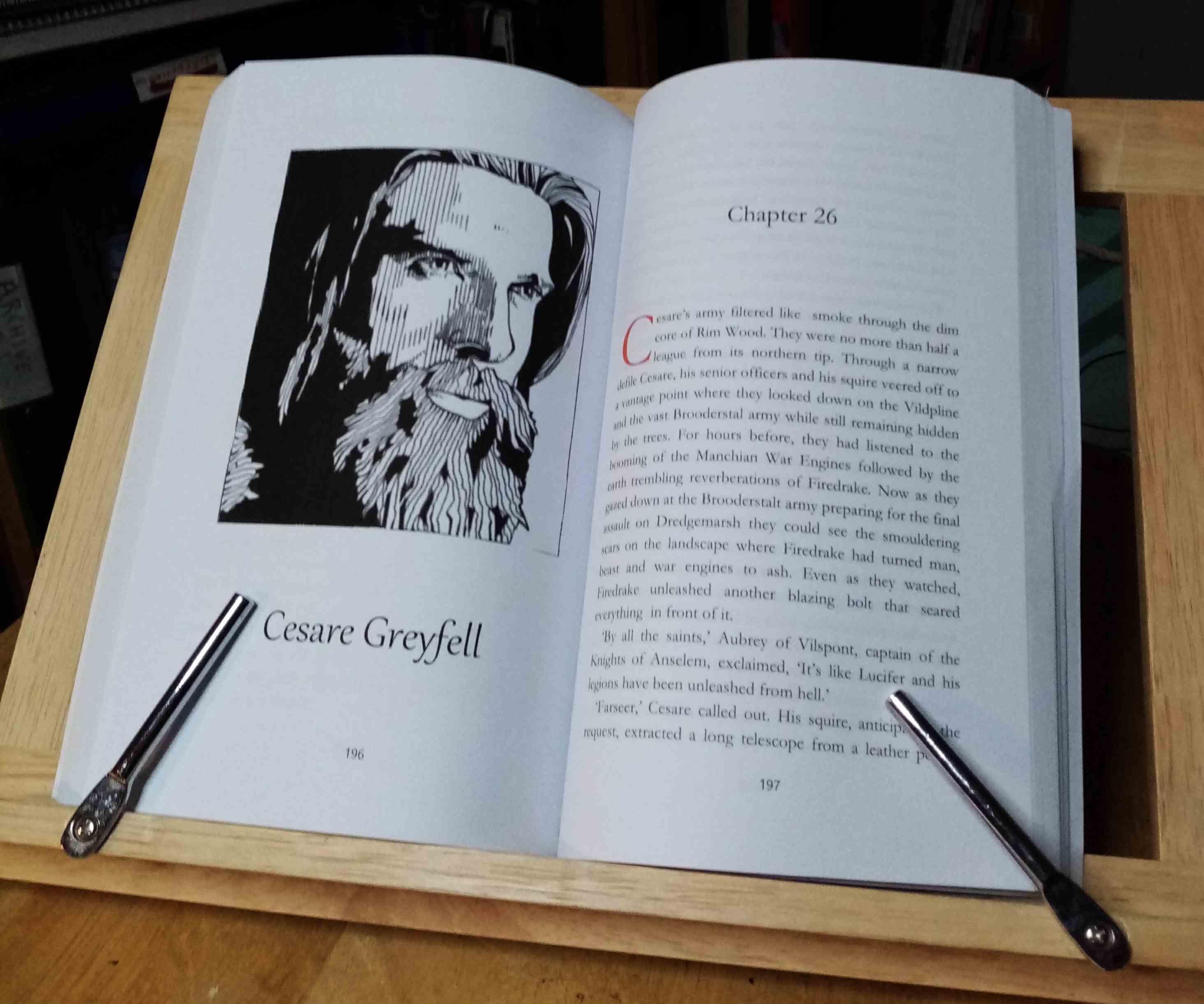
Beyond the storytelling, this book is a work of art. The artwork throughout complements the atmosphere of the text, and the vivid imagery enhances the read. Starting with a map of the Dredgemarsh setting, which was drawn by the author, Dermot McCabe. The typography, too, is impeccable, and I loved the red capital first letter at the beginning of each chapter, along with the portraits of the characters, including the beautiful heroine, Lia Celeste, and the handsome Harry Fairgame. As a writer myself, I can truly appreciate the thought that went into every detail of the book’s design. I checked who did the character portrait illustrations, and McCabe mentions in the acknowledgements that it was his son, Conall McCabe, who created those unique illustrations. I read that ‘Forty Foot Press’, an Irish publisher, published the book; a house to keep an eye on.

Epic and military fiction are at the heart of the cinematic saga, with the Brooderstalt army led by Albrecht Pentrojan marching on the city of Dredgemarsh. Pentrojan is intent on the total annihilation of every living creature within the ancient walls. The Dredgemarsh defenders have little chance of surviving the onslaught. The King is away fighting on another front, and a scandal is unfolding at home, as it has just been revealed that Prince Fabian is not the legitimate heir to the throne. The real heir is Harry Fairgame, a man who was raised in poverty and hardship. Handsome Harry is not just a pretty face, but is highly intelligent, and he might be the man to handle the impossible challenges facing Dredgemarsh.

The romance also kept me intrigued. Lia Celeste, the daughter of General Hawksfoot, fell in love with Harry before his royal ancestry was known, and it was also love at first sight for Harry. However, Lia becomes daunted by the fact that the lowly man she fell in love with is now actually the Prince of Dredgemarsh.

Finally, I can say that Dredgemarsh: Fire and Water is beautifully paced and produced, making it a real ‘experience’. I can wholeheartedly recommend it to readers who enjoy stories that are both visually captivating and narratively compelling. A great read; bravo to the author, Dermot McCabe, for this creation!

Book available at Dredgemarsh : Fire and Water in print and ebook format.

Publisher Forty Foot Press

Reviewer: Patricia Killeen
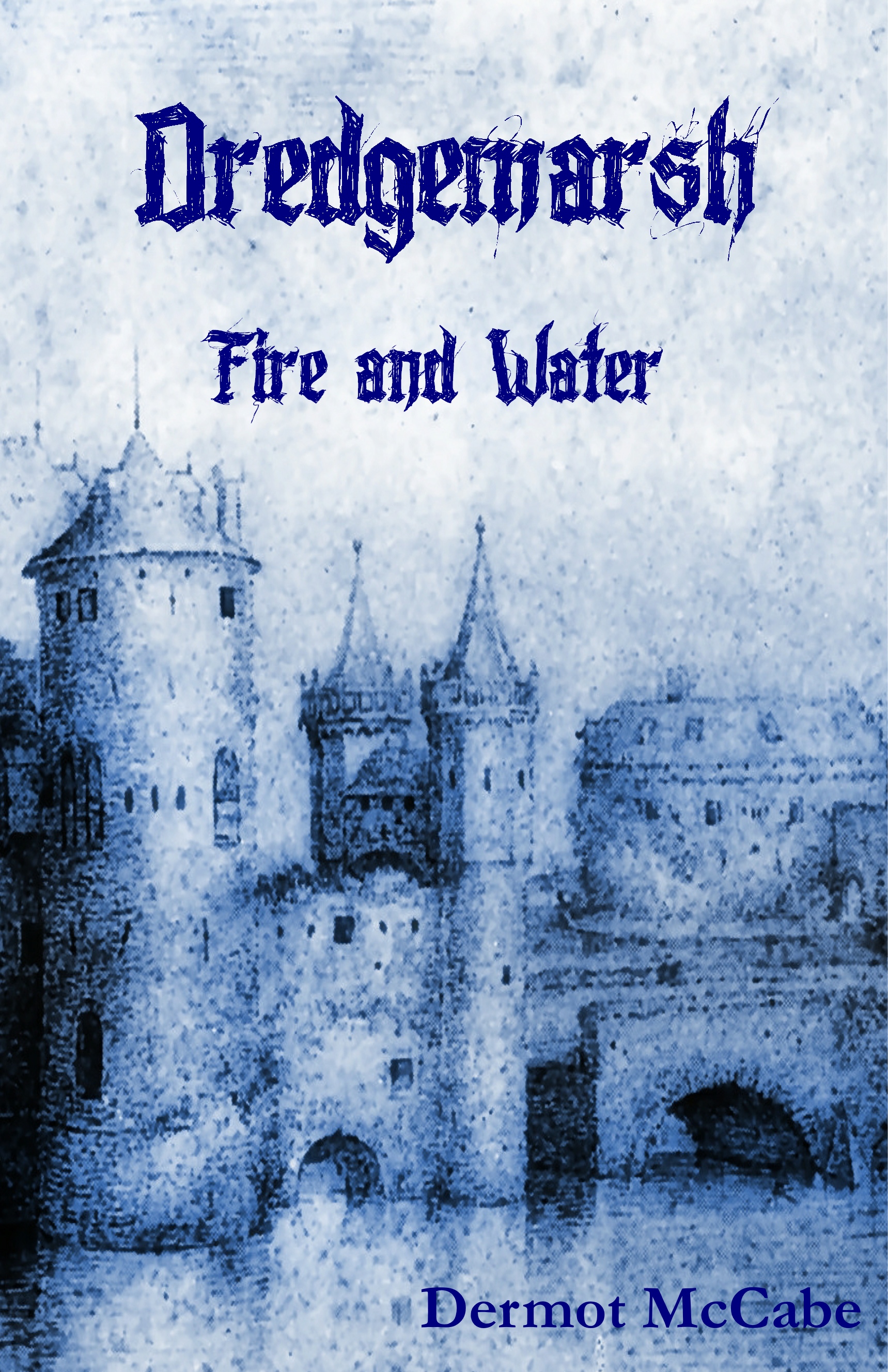
Dredgemarsh : Fire and water

Dermot McCabe’s abiding interest in medieval history and art have manifest themselves in The Dredgemarsh  gothic novels: The Reluctant King, The Lost Prince and the latest book DredgeMarsh – Fire and Water published by Forty Foot Press (Aug 2025). The novels cover two generations of the Greyfells of Dredgemarsh.

These novels are infused with the often rumbustious life in Europe of the 14th Century. There is a dark humour manifest in the lives of the the many Breugal-like inhabitants but behind that lurks the dark seeds of traitorous ambition that seeks to destroy the reign of the Greyfells. The prospect of the destruction of this Gothic Kingdom is ever-present. There are evil forces without but also the flaws of the ruling family themselves that puts the kingdom of Dredgemarsh in the way of great harm.

Love is a critical force that shapes the lives of the rulers of of this kingdom and a strange discovery in the field of optiks may be the key to saving it from ruin.

Within the pages of this beautifully produced book, “Dredgemarsh: Fire and Water” you will experience the rumbunctiousness of Breugal’s Paintings intermingled with brutal warfare, chivalry, honour and love between Harry Fairgame and Lia Celeste and scientific discovery that could change the history of this Peake-like world for ever.

Dregemarsh : Fire and Water (published by Forty Foot Press: https://fortyfootpress.ie/dermotmccabe.html ) is available on Amazon in print and eBook format.

Medieval Warhorse : The Destrier

Destrier is an archaic word for warhorse. It was not a specific breed but was a horse chosen for battle and individual combat at jousting tournaments. As well as having the strength to carry an armoured knight (good armour weighed about 70 lbs)  the Destrier was also trained to inflict injury on the enemy. It was usually a stallion that had to undergo extensive training before being ready for battle. It had to

  • Respond to a knights commands using leg pressure
  • Trample the bodies of fallen enemies
  • Bite and kick on command
  • It needed explosive energy and agility as well as mass.

We can see Destriers being trained from the marginalia of manscript 264 in The Bodleian Library.

Training Horses

Training Horses

Because of the training the Destrier was a very expensive horse. It cost roughly twice that of a Palfrey which was a horse used for travelling because of its comfortable ambling gait. Knights would usually have a Palfrey for day to day journeying with the Destrier reserved for battle or tournaments.

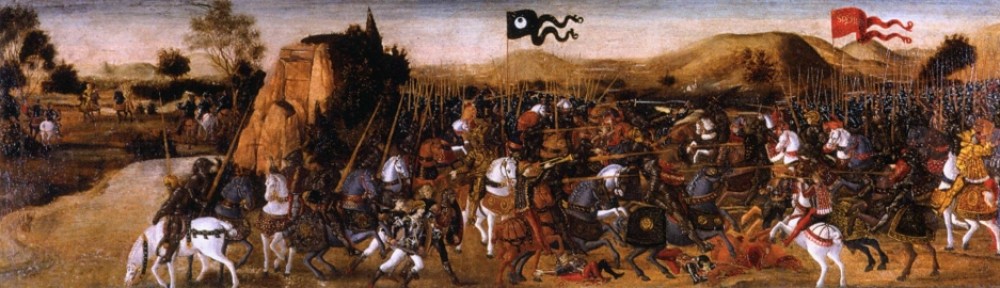
Although it is often assumed that the great draught horses such as the Clydesdale are the descendants of the Destrier it seems unlikely because if one looks at medieval representations of Destriers they were far more like the modern Percheron.

Percheron

Percheron

These magnificent horses typify the conformation of a Destrier. The

St. George by Albrecht Durer

St. George by Albrecht Durer

Percheron stand about 15 to 18 hands (probably a bit taller than the original Destrier), they weigh around 2000 pounds, are heavily muscled and have a low centre of gravity.

It would have been a definite advantage to have a low centre of gravity in a jousting tournament along with explosive speed and power. From paintings of the medieval period we can determine that this is the type of conformation favoured by knights.

[The word destrier comes an from Old French word destre right hand, from Latin dextra; from the fact that a squire led a knight’s horse with his right hand]

The World is a Haystack

“The world is a haystack, and each man plucks from it what he can.”

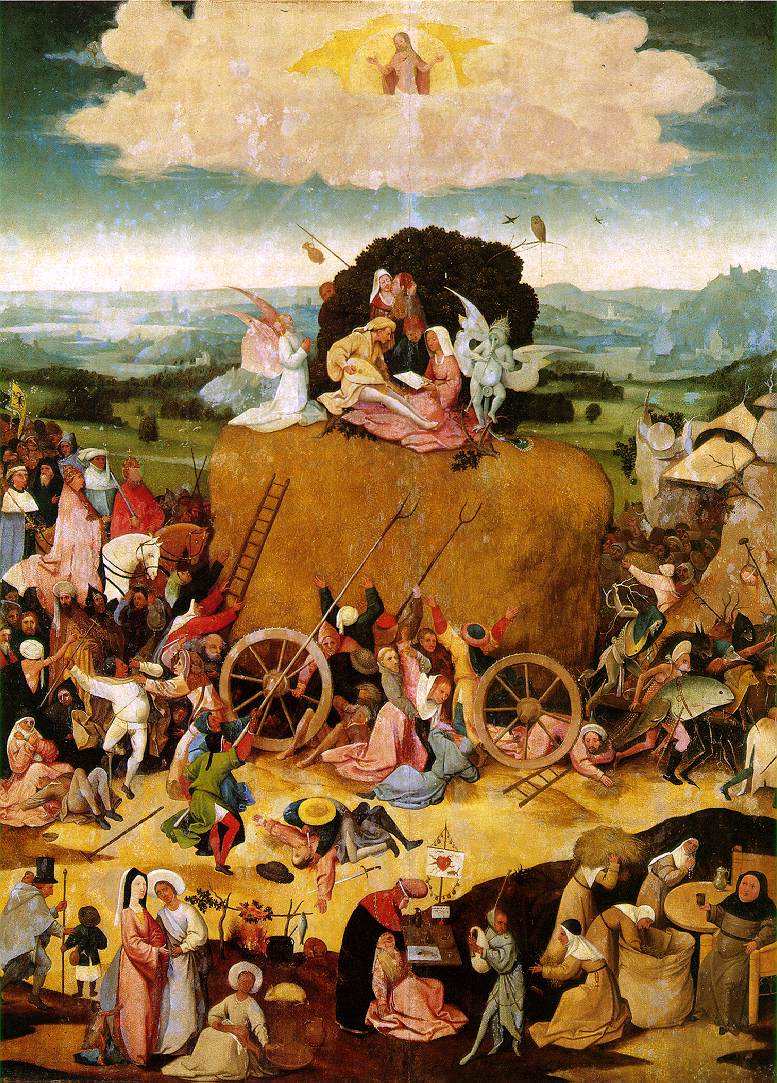
This is a Flemish proverb that is famously illustrated in Hieronymous Bosch’s Haywain. In the central panel of this triptych the Haywain is being pulled by demonic characters – half beast half man – towards hell.

The Haywain by Hieronymus Bosch (1450 – 1516)

People from all walks of life are scrabbling to grab hay from the haywain, oblivious to how it is moving them inexorably towards damnation. All manner of human weakness is portrayed by Bosch: fighting, killing, gluttony and lust. People are being crushed under the wheels of the haywain; lovers and musicians on the top of the hay are so self absorbed that they cannot see what’s happening. The rich and powerful from church and state follow on their horses. An angel gazes towards Heaven where Christ looks down with what might well be interpreted as a gesture of despair at the foolishness of mankind.
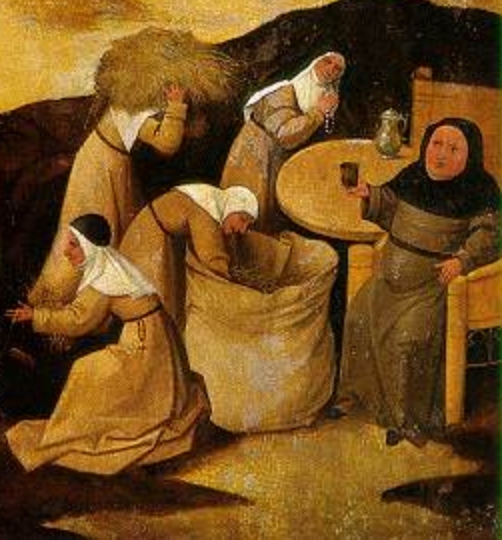
What is striking in this picture is the depiction of the clergy. On the bottom right hand of the central panel a group of nuns are busily filling a large sack with hay, watched over by a fat abbess who is comfortably seated and drinking while overseeing the work. One of the rich followers behind the haywain is clearly a bishop on a white horse.

Detail from The Haywain – Nuns filling a sack with hay, watched over by the abbess

In another of Bosches works ‘Ship of Fools’ the priest and nun are very prominent. The ship (life) drifts aimlessly while the occupants are preoccupied with their own desires and diversions.

The Ship of Fools by Hieronymous Bosch (1450 – 1516)

This view of the clergy is not uncommon in medieval times.

William Langland, in his great allegorical poem, PiersPlowman, is scathing in his portrayal of of the contemporary church(14th century). He depicts friars as fraudsters and liars given to greed, drunkenness and promiscuity with courtesans and concubines.

Chaucer in his Canterbury Tales is equally cynical with his portrayal of the “fat and personable priest” who loves hunting, expensive clothes, jewellery and “a fat swan, and roasted whole.” His description of a friar is equally damning:

“He kept his tippet stuffed with pins for curls
And pocket-knives, to give to pretty girls.

He knew the taverns well in every town
And every innkeeper and barmaid too
Better than lepers, beggars and that crew,
For in so eminent a man as he
It was not fitting with the dignity
Of his position, dealing with a scum
Of wretched lepers; nothing good can come
Of dealing with the slum-and-gutter dwellers,
But only with the rich and victual sellers.”

Apart from the clergy’s hypocrisy, what irked and infuriated the peasant class in respect of them was the imposition of tithes on what little wealth they could glean from their labours. The church demanded a tenth of their crops and livestock each year. If they did not pay they could be punished by incarceration and excommunication. It is little wonder that peasants were attracted to some of the heretical teachings and their promoters who railed against the greed and mendacity of the established church.