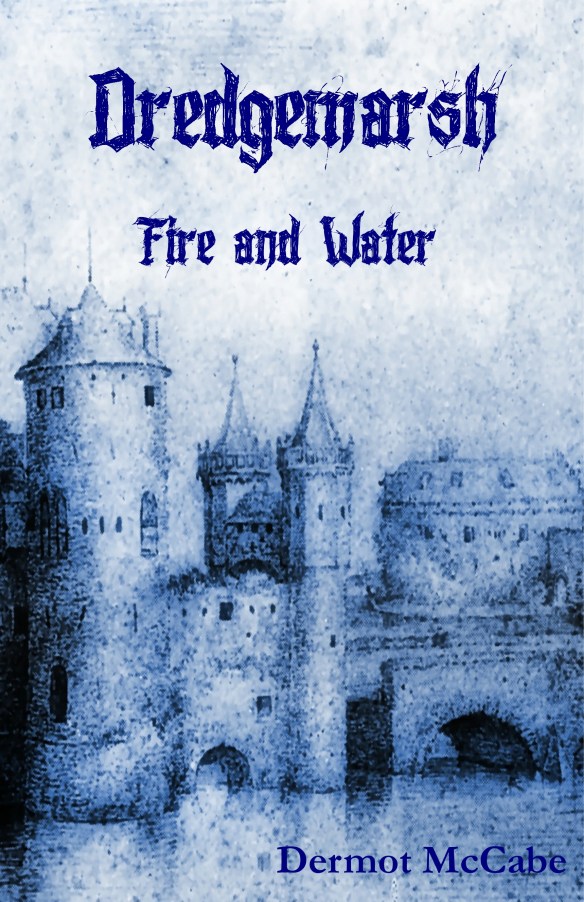
Dredgemarsh : Fire and Water Review

Review by Patricia Killeen

Dredgemarsh: Fire and Water is a stunning book by writer Dermot McCabe—I didn’t expect to enjoy it so much, as I’m not usually into medieval world type sagas, and as I borrowed it from my daughter, I think its probably a more ‘young adult historical adventure genre’, but the story grabbed me from the first page and just refused to let go. The writing flows, and I was surprised to be seduced into a mythical world that also felt weirdly intimate.

Beyond the storytelling, this book is a work of art. The artwork throughout complements the atmosphere of the text, and the vivid imagery enhances the read. Starting with a map of the Dredgemarsh setting, which was drawn by the author, Dermot McCabe. The typography, too, is impeccable, and I loved the red capital first letter at the beginning of each chapter, along with the portraits of the characters, including the beautiful heroine, Lia Celeste, and the handsome Harry Fairgame. As a writer myself, I can truly appreciate the thought that went into every detail of the book’s design. I checked who did the character portrait illustrations, and McCabe mentions in the acknowledgements that it was his son, Conall McCabe, who created those unique illustrations. I read that ‘Forty Foot Press’, an Irish publisher, published the book; a house to keep an eye on.

Epic and military fiction are at the heart of the cinematic saga, with the Brooderstalt army led by Albrecht Pentrojan marching on the city of Dredgemarsh. Pentrojan is intent on the total annihilation of every living creature within the ancient walls. The Dredgemarsh defenders have little chance of surviving the onslaught. The King is away fighting on another front, and a scandal is unfolding at home, as it has just been revealed that Prince Fabian is not the legitimate heir to the throne. The real heir is Harry Fairgame, a man who was raised in poverty and hardship. Handsome Harry is not just a pretty face, but is highly intelligent, and he might be the man to handle the impossible challenges facing Dredgemarsh.

The romance also kept me intrigued. Lia Celeste, the daughter of General Hawksfoot, fell in love with Harry before his royal ancestry was known, and it was also love at first sight for Harry. However, Lia becomes daunted by the fact that the lowly man she fell in love with is now actually the Prince of Dredgemarsh.

Finally, I can say that Dredgemarsh: Fire and Water is beautifully paced and produced, making it a real ‘experience’. I can wholeheartedly recommend it to readers who enjoy stories that are both visually captivating and narratively compelling. A great read; bravo to the author, Dermot McCabe, for this creation!

Book available at Dredgemarsh : Fire and Water in print and ebook format.

Publisher Forty Foot Press

Reviewer: Patricia Killeen

The Invention of the Irish Harp – A Fishy story

In the year 592 the chief poet of Ireland, Dalian Forgaill, died. By unanimous consent of the ollamhs and professors of Poetry, his mantle was conferred on the young poet Seanchun.Tradition dictated that the new chief poet should confer the honour of his first visit, with his retinue of ollamhs,  to a King he admired and respected. That King was Guaire the Hospitable, king of Connacht.

During that visit, King Guaire invited his brother, Marbhan, a reclusive holy man to help with his demanding guests. Marban had retired from court to pray and meditate in Glenn Dallun. He related to  the guests, who offered to play the Cruit (Harp) for him how the Cruit was invented. His story was as follows:

‘There once lived a couple [a man and his wife] , Cuil the son of Midhuel was the man, and Canoclach Mhor was his wife. And the wife conceived a hatred to him, and she was [always] flying from him through woods and wildernesses ; and he continued to follow her constantly.

‘And one day that the woman came to the sea shore of Camas, and was walking over the strand, she met a skeleton of a whale on the strand, and she heard the sounds of the wind passing through the sinews of the whale on the strand ; and she fell asleep from the sounds. And her husband came after her [and found her asleep] ; and he perceived that it was from the soundsthe sleep fell upon her. 

‘And he then went forward into the wood, and made the form of the Cruit; and he put strings from the sinews of the whale into it ; and that was the first Cruit that was ever made.’

Castledermot High Cross

19th Century High Cross at Castledermot, Kildare, Ireland. On the left hand side is a depiction of David playing the Harp or Cruit. The first mention of a harp in Irish Mythology – History is in the history of the Tuatha De Danaan (1800 BC)at the 2nd battle of Magh Tuireadh.

A Message from 18th Century for Brexiters

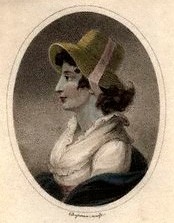
Anna Laetitia Barbould

Anna Laetitia Barbauld 1743 – 1825

Anna Laetitia Barbauld, was a remarkable woman who wrote, poetry, essays and text books for children as well as writing pamphlets on serious social and political issues of the day. She was highly critical of the war between England and France. She predicted that England would not maintain its position of dominance in the world, a very unpopular view which resulted in her rejection by the establishment and abandonment by many literary friends who were initially great admirers of her writing.

This extract from Juvenalia seems very apt to the present day and the madness that is Brexit. Here she warns against the unheeded dangers of Britain ignoring the consequences that would follow its continued animosity with France.

“And think’st thou, Britain, still to sit at ease,
An island Queen amidst thy subject seas,
While the vext billows, in their distant roar,
But soothe thy slumbers, and but kiss thy shore?
To sport in wars, while danger keeps aloof,
Thy grassy turf unbruised by hostile hoof?
So sing thy flatterers; but, Britain, know,
Thou who hast shared the guilt must share the woe.
Nor distant is the hour; low murmurs spread,
And whispered fears, creating what they dread;
Ruin, as with an earthquake shock, is here”